
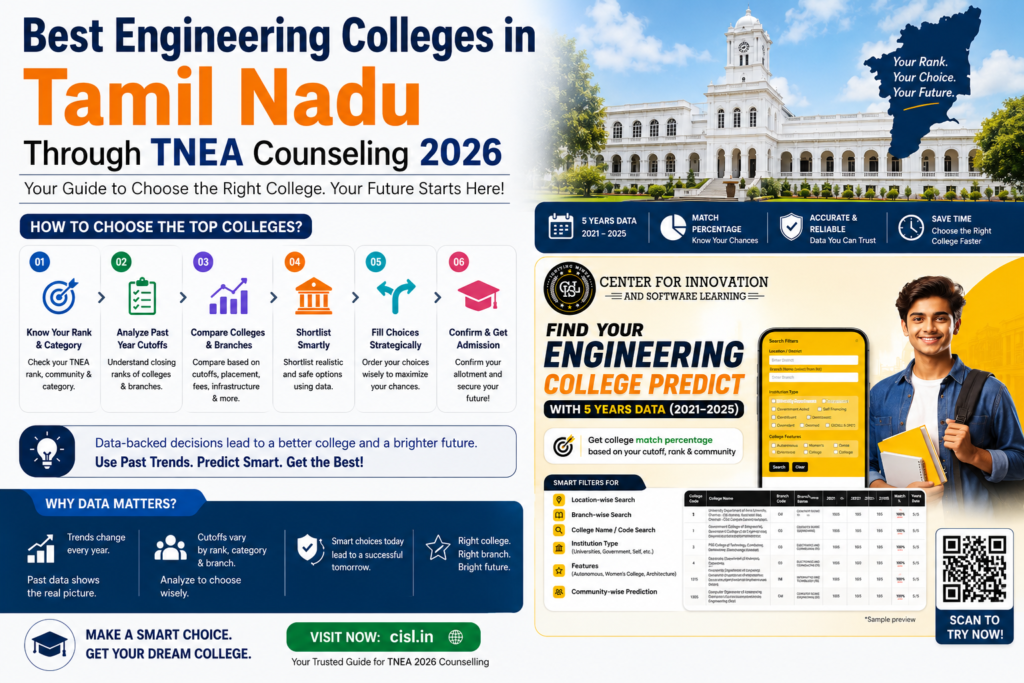
Tamil Nadu is one of India’s major destinations for engineering education. Every year, students across the state participate in Tamil Nadu Engineering Admissions (TNEA) counselling to explore undergraduate engineering opportunities at government, government-aided and self-financing colleges.
Choosing the right engineering college is an important decision that can influence a student’s learning experience and career opportunities. Academic quality, placement opportunities, faculty, fees, location, infrastructure and branch availability are some of the factors students should consider before making their choices.
This guide introduces several well-known engineering institutions in Tamil Nadu, popular engineering branches and practical tips for evaluating colleges during the 2026 admission cycle.
How Students Choose Engineering Colleges
Students should compare multiple factors instead of selecting a college based only on its name or popularity. The following points can help create a practical shortlist.
- Previous-year TNEA cutoff trends for the preferred branch.
- Placement statistics and the types of companies recruiting students.
- Availability of preferred branches and specialisations.
- Academic reputation, faculty and learning facilities.
- Tuition fees, hostel expenses and scholarship opportunities.
- Internships, industry projects and practical learning opportunities.
- Location, transport facilities and campus environment.
Cutoff trends may change from year to year depending on applicant preferences, seat availability, branch demand and the relevant counselling category. Previous-year cutoffs are useful for estimating admission possibilities, but they do not guarantee admission.
Top Government Engineering Colleges in Tamil Nadu
Government engineering institutions are popular among students seeking established academic programmes and comparatively affordable tuition. Actual fees and eligibility should always be checked using the latest official information.
1. College of Engineering, Guindy (CEG), Chennai
The College of Engineering, Guindy, part of Anna University, is one of the established engineering institutions in Tamil Nadu. It attracts students interested in a range of engineering disciplines, including computing, electronics and traditional engineering fields.
What students should explore:
- Computer Science and Engineering.
- Electronics and Communication Engineering.
- Information Technology and other available programmes.
- Faculty expertise, research activities and laboratory facilities.
- Official placement reports and department-specific opportunities.
Students interested in CEG should review the latest branch-wise cutoff information and the official programme details before preparing their counselling choices.
2. Madras Institute of Technology (MIT), Chennai
Madras Institute of Technology is a constituent institution of Anna University. It is known for engineering and technology education, with programmes covering areas such as aeronautical engineering, electronics, computing and other technical disciplines.
What students should explore:
- Available computing and electronics programmes.
- Aeronautical and other specialised engineering disciplines.
- Laboratory facilities, technical projects and research activities.
- Current admission requirements and branch-wise cutoff trends.
Students should compare the available programmes with their academic interests and long-term career plans.
3. Government College of Technology (GCT), Coimbatore
Government College of Technology, Coimbatore, is an established government engineering institution. It is worth considering for students exploring engineering education in Coimbatore and surrounding districts.
What students should explore:
- Available engineering branches and specialisations.
- Academic facilities and practical laboratory experience.
- Placement opportunities in core engineering and technology sectors.
- Tuition fees, hostel facilities and transport arrangements.
Check the current admission brochure to confirm the courses offered, eligibility requirements and applicable fees.
Popular Private and Government-Aided Engineering Colleges
Tamil Nadu also has several well-known private and government-aided institutions. Students should compare the specific programme, teaching quality, total cost and verified placement information when evaluating these colleges.
4. PSG College of Technology, Coimbatore
PSG College of Technology is a well-known engineering institution in Coimbatore. Students considering the college can explore its engineering programmes, academic facilities and links with industry.
- Review the available computing, electronics and core engineering branches.
- Compare department-specific placement reports.
- Explore technical projects, internships and industry collaborations.
- Check fees, scholarships and admission requirements.
5. SSN College of Engineering, Kalavakkam
SSN College of Engineering is a recognised engineering institution in Tamil Nadu. Students can evaluate its available undergraduate programmes, academic environment and career-development opportunities.
- Explore Computer Science, Information Technology and other available branches.
- Review verified placement reports and recruiting company information.
- Check laboratory facilities, projects and internship support.
- Compare tuition fees and available scholarships.
6. Thiagarajar College of Engineering (TCE), Madurai
Thiagarajar College of Engineering in Madurai is another established institution for students exploring engineering programmes in southern Tamil Nadu.
- Compare the available engineering branches and curriculum.
- Research core-sector and software-sector placement opportunities.
- Explore project work, technical activities and industry exposure.
- Check the latest admission, fee and scholarship details.
Most Preferred Engineering Branches in 2026
The right engineering branch depends on a student’s interests, strengths and career goals. Popularity alone should not determine the decision.
Computer Science and Engineering (CSE)
Computer Science and Engineering focuses on programming, algorithms, software development, databases, computer systems and related areas. It can be a suitable option for students interested in building software products and solving computational problems.
- Software development and application engineering.
- Data structures, algorithms and computer systems.
- Web development, cloud computing and software architecture.
- Artificial intelligence and other advanced computing fields.
Artificial Intelligence and Data Science (AI & DS)
AI and Data Science programmes generally cover areas such as programming, statistics, data analysis, machine learning and artificial intelligence. The exact curriculum varies by institution.
- Data analytics and data visualisation.
- Machine learning and predictive modelling.
- AI applications and intelligent systems.
- Statistical methods and data-driven problem-solving.
Information Technology (IT)
Information Technology focuses on computing systems and the technologies used to develop, manage and maintain digital solutions. Depending on the curriculum, students may study software engineering, databases, networks, cybersecurity and cloud technologies.
Electronics and Communication Engineering (ECE)
ECE combines electronics, communication systems and related technologies. It can provide pathways into electronics, embedded systems, semiconductor technologies and certain software-related roles.
- Embedded systems and microcontrollers.
- Communication systems and signal processing.
- VLSI and semiconductor-related technologies.
- Electronics design, testing and related software applications.
Factors to Consider Before Choosing an Engineering College
1. Placement Performance
Look beyond advertised highest salary packages. Review the most recent placement report and consider the following:
- Placement percentage and the number of eligible students.
- Median salary, where published, and the distribution of offers.
- Recruiting companies and the roles offered.
- Department-specific outcomes and internship opportunities.
2. Accreditation and Academic Recognition
Verify the institution’s recognition and the status of the specific programme. Check relevant NBA accreditation, NAAC accreditation or grade, university affiliation and autonomous status using official sources. These are different indicators and should not be treated as interchangeable.
3. Location and Campus Facilities
Location can affect daily travel, living expenses and access to internships or industry events. Compare transport, hostel availability, laboratories, libraries, campus facilities and the overall learning environment.
4. Fees and Scholarships
Calculate the total cost of education rather than tuition alone. Consider hostel charges, food, transport, examination fees, equipment and other applicable expenses. Check eligibility for scholarships and financial assistance before finalising a college.
5. Curriculum and Practical Learning
Review the syllabus, laboratory sessions, capstone projects, internships and opportunities to work with industry. Practical experience can help students connect academic concepts with real-world applications.
Importance of Previous-Year TNEA Cutoff Analysis
Previous-year cutoff data can help students understand how competitive particular college and branch combinations have been during earlier counselling rounds.
Cutoff analysis can help students:
- Estimate their admission possibilities using relevant historical data.
- Identify ambitious, realistic and safer college choices.
- Compare different branches within the same institution.
- Explore options across locations and college types.
- Prepare a more balanced counselling preference list.
Find Engineering Colleges That Match Your Cutoff
Not sure which engineering colleges to consider based on your cutoff? Use the CISL College Predictor to explore college options using available historical cutoff data and relevant admission preferences.
Compare potential colleges and branches before preparing your TNEA counselling choices. Remember that previous-year data provides guidance, not a guarantee of admission.
Explore the CISL College PredictorPractical Tips for TNEA Counselling 2026
Include a Balanced Range of Colleges
Do not restrict your choices to only the most competitive institutions. Research a range of colleges and branches based on your cutoff, preferences and the available historical data.
Choose a Branch That Matches Your Interests
Consider the subjects you enjoy, the skills you want to develop and the careers you may pursue. A popular branch may not be the best fit for every student.
Research Placement History Carefully
Review published placement reports and compare outcomes across departments. Do not make a decision based only on advertisements or an isolated highest-salary figure.
Check Official Admission Information
Verify eligibility, seat availability, branch details, fees and counselling procedures using the latest official TNEA and institutional information. Rules and admission details may change between academic years.
Prepare Your Choices Before Counselling
Create a shortlist of preferred colleges and branches. Compare your options systematically, keep your budget in mind and review the current counselling instructions before submitting preferences.
Conclusion
Tamil Nadu offers a wide range of engineering education opportunities through government, government-aided and private institutions. The best choice depends on the student’s academic profile, preferred branch, financial situation, location and career objectives.
Before finalising a college, compare previous-year cutoffs, curriculum, verified placement information, fees and available facilities. Use historical data as a guide while remembering that admission outcomes can change every year.
If you are preparing for TNEA counselling, start researching your options early and build a balanced list of colleges and branches that match your goals.
Plan Your Engineering College Choices with CISL
Explore college options and compare historical cutoff information using the CISL College Predictor.
Find Your CollegeNote: College descriptions are general informational summaries, not an official ranking. Course availability, fees, accreditation, placements and admission requirements should be verified with the respective institutions and official admission authorities.